Define the boundaries before the model
The most consequential seating decisions may happen before an optimiser runs. Write down what is known, what may change and who has authority to confirm it.
Establish a trustworthy base
Begin with a controlled set of drawings, survey information and operational records. Identify the revision, coordinate system, units and author of each source. A seating model assembled from several drawing versions may look internally consistent while placing a barrier, stair or entrance in the wrong location. Resolve discrepancies or mark the affected area as uncertain before searching for alternatives.
Record the difference between permanent construction and event-specific equipment. Retractable seating, temporary platforms, broadcast positions and hospitality overlays can change the usable arrangement. Link model elements to a source where practical, and make someone responsible for each unresolved measurement. ISO 19650 can inform information-management discipline where it is relevant to the project, but a named standard is not evidence that the underlying survey is accurate.
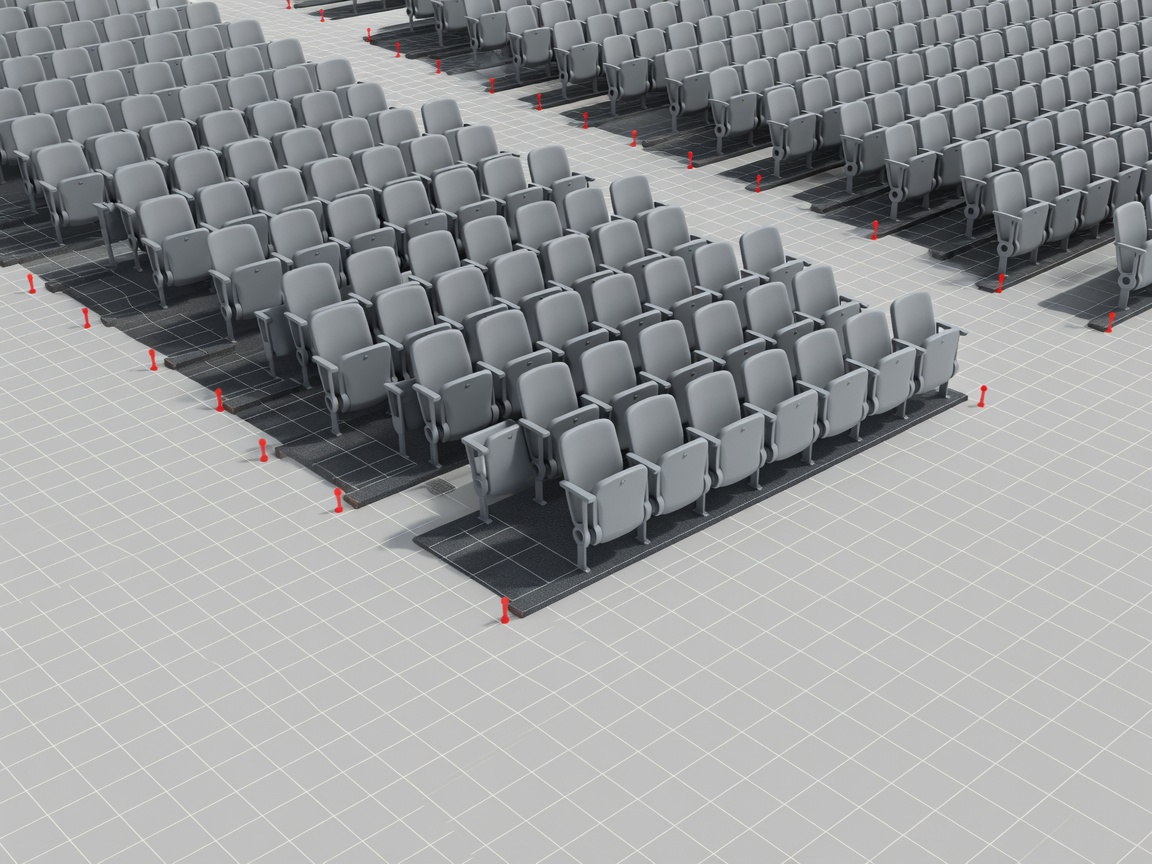
Separate rules from preferences
A hard constraint excludes a proposal from the permitted search space. A preference helps rank otherwise acceptable proposals. Confusing these categories can produce misleading results: a safety-related condition must not become a negotiable penalty simply because that makes the software easier to configure. Conversely, an internal preference should not quietly be presented as a legal requirement.
For each condition, state its source, scope, owner and verification method. Applicable requirements may involve local building and fire provisions, accessibility duties and venue-specific approvals. EN 13200, the spectator-facilities series, may be relevant to parts of a project; the responsible professional must establish which provisions and editions apply. Do not copy dimensions from an unrelated venue or infer compliance from a product’s marketing description.
Describe the event, not a generic crowd
Attendance alone is an incomplete demand input. Arrival timing, entrance allocation, visitor familiarity and the availability of concessions can affect circulation. A football match, concert and family event may use the same structure differently. Define the event configuration before comparing layouts and keep it constant when the purpose is to isolate the effect of a seating change.
Document staffing, ticket checks, open gates and temporary restrictions. Include the assumptions behind any distribution of movement speeds or route choices. If evidence is sparse, create a bounded set of scenarios rather than one confident forecast. The output should preserve those distinctions: an estimate under assumed staffing must not be reported as a promise that the venue will perform that way regardless of operations.

Use the least sensitive useful data
Many early layout studies can work with geometry, aggregate attendance and synthetic demand profiles. Individual ticket records, camera-derived trajectories or identifiable access requests are not automatically necessary. Define the planning question first, then assess whether a less intrusive dataset can answer it. Aggregation reduces some risks but does not guarantee that people cannot be identified.
Where personal data is involved, establish the controller, purpose, lawful basis, access controls and retention rules. The General Data Protection Regulation applies according to its scope; special-category information requires additional care. Consult the responsible privacy specialist about whether a data protection impact assessment is needed. Do not upload identifiable visitor records to a general-purpose AI service simply because it accepts spreadsheet files.
Ask before collecting
Would a synthetic scenario answer this question? If not, which specific observation is missing, and how will it change the decision?
Record the purpose before choosing the dataset or tool.
Package a brief someone else can test
A usable model brief includes the baseline layout, permitted changes, constraint register, event scenarios and evaluation measures. Add a list of exclusions and unresolved issues. State which outputs are exploratory and which require formal verification. Keep a versioned record of changes so that a later result can be traced to the exact inputs that produced it.
Before a major search, run a simple baseline case and inspect it with venue operations and access representatives. Check that routes connect, demand totals reconcile and protected areas are represented. Deliberately test a clearly unacceptable candidate to see whether the process rejects it. An optimiser that produces attractive alternatives but cannot expose a broken constraint is not ready to support a consequential planning decision.
Reference starting points: ISO, CEN-CENELEC and the European Commission’s data protection information.
Next: compare scenarios