Compare more than seat totals
An alternative earns attention by showing where it helps, whom it affects and which assumptions it depends on. A single score cannot tell that whole story.
Ask each method the right question
The label “AI” covers several different activities. A generative tool might propose arrangements; mathematical optimisation can search a defined set of variables and constraints; a machine-learning model may estimate an outcome from examples. Pedestrian simulation examines movement under specified geometry and behavioural assumptions. These methods can be combined, but their outputs should not be treated as interchangeable evidence.
Start with a question that can be tested. “Which entrance assignments reduce the longest modelled journeys under this arrival profile?” is more useful than “What is the best stadium layout?” Record what the method can change and what it holds fixed. If a tool cannot reveal its constraints, assumptions or evaluation method, its recommendations are difficult to audit and should carry correspondingly limited weight.
Keep a baseline that can be challenged
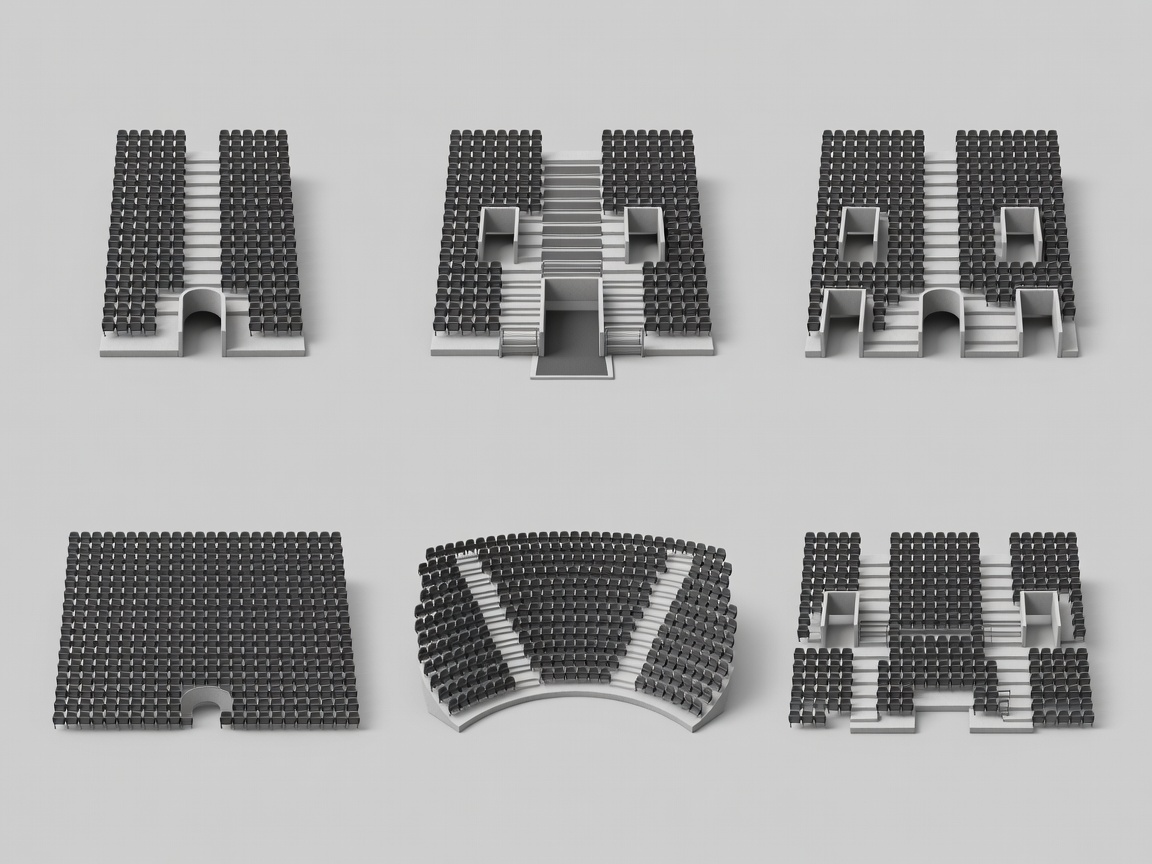
Compare proposed arrangements with a documented baseline using the same demand, geometry conventions and reporting measures. The existing layout is not automatically a perfect reference; it may contain known weaknesses or incomplete survey information. Make those limitations explicit rather than treating the current condition as validated simply because it is familiar.
Change one factor at a time during early exploration where possible. This helps reveal whether a result comes from moving an aisle, changing entrance allocation or quietly assuming more staff. Later, combined scenarios can examine interactions. Preserve rejected alternatives when they explain a significant trade-off. A traceable decision history is more informative than a gallery containing only the winning render.
Choose measures that expose the trade-off
Capacity matters, but it is only one outcome. Compare accessible viewing choices, route continuity, sightline assessments, local queueing and operational requirements alongside seat totals. Break down results by relevant area and journey rather than relying only on an overall average. A small average improvement may coexist with a substantially worse route for a particular seating block.
Do not collapse incompatible outcomes into one weighted score without showing the weights and their consequences. Multi-objective optimisation can identify alternatives where improving one objective would worsen another, often described as a Pareto frontier. That does not choose the right trade-off for the venue. It makes the available choices clearer so accountable people can discuss them.
| Measure | Baseline | Alternative |
|---|---|---|
| Visitor route | Which journeys are longest? | Who gains or loses? |
| Access choice | Where are usable positions? | Is choice maintained? |
| Operations | What staffing is assumed? | What new dependency appears? |
| Uncertainty | Which inputs are estimated? | Does the ranking change? |
Look for fragile improvements
A proposal may perform well only when one uncertain input takes a favourable value. Test plausible variations in arrival timing, route preference, facility availability and operating arrangements. Where the method is stochastic, use repeated runs and report variability rather than selecting a convenient animation. Keep modelled estimates separate from observations collected at the venue.
Sensitivity testing asks whether conclusions survive reasonable changes. Validation asks how well the model represents relevant real conditions; calibration adjusts parameters against evidence. These are related but distinct tasks. Avoid calibrating and declaring success on exactly the same limited observations without independent checking. If observations are unavailable, say so and keep the recommendation exploratory rather than implying proven operational performance.
Publish the uncertainty beside the proposal
A review pack should include the baseline, candidate changes, input revisions, method, assumptions and unresolved constraints. Present understandable diagrams with the numerical measures, and avoid colour-only explanations. Explain what a result means in operational terms: where a queue moves, which route depends on assistance and what staff would need to do differently.
Guidance from bodies such as the Sports Grounds Safety Authority and the UK Health and Safety Executive can help frame crowd-management questions, while FIFA and UEFA publish material relevant to football venues within their respective contexts. These are reference points, not interchangeable approval authorities. Event rules, local requirements and professional responsibilities still need to be established for the specific venue before a preferred alternative becomes an implementation plan.
A responsible conclusion
State the observed or modelled benefit, the affected groups, the conditions required and the remaining checks. “Preferred for further review” is often the appropriate outcome.
Further reading: HSE event safety, SGSA, FIFA and UEFA. No affiliation is implied.
Next: human review